
Pigtail Catheter Explained: Types, Uses, Insertion & Nursing Care (Complete Guide for Nurses
Meta Description:
Learn what a pigtail catheter is, types of pigtail catheters, indications, insertion steps, complications, and essential nursing care. A complete, easy-to-understand guide for nurses.
—
🩺 Introduction
In today’s modern healthcare settings, minimally invasive procedures are widely preferred to reduce patient discomfort and complications. One such innovation is the pigtail catheter, a small yet powerful medical device used for draining air, fluid, abscess, bile, or urine from different body cavities.
For nurses, understanding what a pigtail line is, when it is used, and how to care for a patient with one is essential for safe and efficient patient care.
This article simplifies everything you need to know about pigtail catheters in a clear, easy-to-read, and nursing-friendly format.
—✅ What Is a Pigtail Catheter?
A pigtail catheter is a thin, flexible tube designed with a curled, pigtail-shaped tip that helps keep it securely in place once inserted inside the body.
It is commonly inserted under:
Ultrasound guidance
CT guidance
Bedside technique (for pneumothorax)
The curled tip reduces the risk of:
Dislodgement
Tissue injury
Leakage
Pigtail catheters are now widely used as an alternative to large chest tubes due to being less painful, more comfortable, and equally effective for many conditions.
—
 in
in
✅ How a Pigtail Line Works
The pigtail catheter contains:
A curled end (locking loop)
Side holes for drainage
A locking mechanism
Connecting tubing
A drainage bag or collection bottle
Once inserted, the catheter:
1. Curls inside the cavity
2. Locks in place
3. Allows continuous drainage
—
✅ Indications for Pigtail Catheter
Pigtail catheters are used in many clinical conditions, including:
✅ Respiratory
Pneumothorax
Pleural effusion
Empyema
Post-operative chest drainage
✅ Abdominal
Ascites drainage
Abdominal fluid collection
Peritoneal abscess
✅ Urinary
Obstructed kidneys (nephrostomy)
Pyonephrosis
Urinary backup due to stones
✅ Liver & Biliary System
Liver abscess drainage
Biliary obstruction
Gallbladder drainage
✅ Soft-Tissue Abscesses
Pelvic abscess
Appendicular abscess
Psoas muscle abscess
—
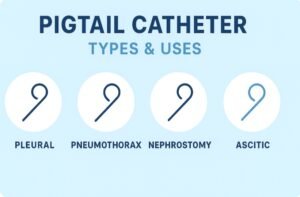
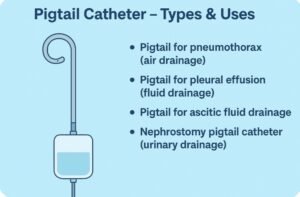
✅ Types of Pigtail Catheters (Explained for Nurses)
Below are the 6 major types used in hospital settings:
—
🔵 1. Pigtail Catheter for Pneumothorax (Air Drainage)
Purpose: To remove air from pleural space.
Used for:
Primary spontaneous pneumothorax
Secondary pneumothorax
Post-procedure pneumothorax (central line insertion, biopsy)
Size: 8–14 French
Advantage:
Less discomfort compared to chest tubes.
—
🔵 2. Pigtail Catheter for Pleural Effusion (Fluid Drainage)
Purpose: Drains fluid from chest cavity.
Used for:
Pleural effusion
Malignant effusion
Empyema
Mild hemothorax
Size: 12–16 French
Advantage:
Safe for both diagnostic and therapeutic thoracentesis.
—
🔵 3. Ascitic Drainage Pigtail
Purpose: Removes fluid from abdominal cavity.
Used for:
Liver cirrhosis with ascites
Malignant ascites
Refractory ascites
Size: 8–12 French
—
🔵 4. Nephrostomy Pigtail (Kidney Drainage)
Purpose: Drains urine directly from renal pelvis.
Used for:
Ureter obstruction
Renal stones
Tumors blocking urine flow
Severe infection (pyonephrosis)
Size: 8–12 French
—
🔵 5. Biliary Pigtail Catheter
Purpose: Drains bile from gallbladder or bile ducts.
Used for:
Acute cholecystitis
Biliary obstruction
Post-operative leaks
Size: 8–10 French
—
🔵 6. Abscess Drainage Pigtail
Purpose: Drains pus from infected areas.
Used for:
Liver abscess
Pelvic abscess
Kidney abscess
Soft-tissue abscesses
Size: 8–14 French
—
✅ How Pigtail Catheter Is Inserted (Step-by-Step Simplified)
Usually inserted by:
Radiologist
Pulmonologist
Surgeon
Emergency physician
✅ Procedure Steps (General)
1. Patient assessment & consent
2. Ultrasound/CT guidance
3. Sterile preparation
4. Local anesthesia administration
5. Small skin puncture
6. Needle insertion into cavity
7. Guidewire passed inside
8. Catheter advanced over wire
9. Pigtail curled & locked
10. Connected to drainage system
11. Secured with sutures & dressing
Total time: 10–20 minutes
—
✅ Nursing Care for Patients With Pigtail Catheter
Nurses play the most important role in preventing infection and ensuring drainage.
✅ 1. Monitor Drainage
Amount (hourly/shift-based)
Color
Consistency
Sudden stop of drainage = obstruction
Sudden increase = possible bleeding
—
✅ 2. Maintain Sterile Technique
Keep site clean
Change dressing as per protocol
Avoid unnecessary handling
—
✅ 3. Check Catheter Position
Ensure no kinking
Ensure the catheter is not pulled
Check the securing suture
—
✅ 4. Ensure Proper Bag Placement
Drainage bag must be:
Below the insertion site
Not touching the floor
Properly connected
—
✅ 5. Assess for Complications
Fever
Redness
Leakage
Pain
Air leak or bubbling (for chest pigtails)
—
✅ 6. Flushing (If Prescribed)
Some catheters require regular flushing to avoid blockage.
Use:
0.9% Normal saline
Strict aseptic technique
—
✅ Complications of Pigtail Catheter
Most complications are preventable with nursing vigilance.
Bleeding
Infection
Accidental dislodgement
Catheter blockage
Pain
Pneumothorax (rarely during abdominal procedures)
—
✅ Advantages of Pigtail Catheters
Minimally invasive
More comfortable than large chest tubes
Suitable for bedside insertion
Lower pain & complications
Ideal for elderly and high-risk patients
—
✅ Conclusion
Pigtail catheters have become a go-to solution for doctors and nurses due to their simplicity, safety, and effectiveness. Whether used for air, fluid, pus, bile, or urine drainage, pigtail catheters provide a quick and minimally invasive way to manage many conditions.
Understanding types, uses, procedure steps, and nursing responsibilities helps nurses give safe and high-quality care to their patients.